The part of CS that AI is replacing. And the part it can't touch.
There's a line running through every CS role right now. On one side: the work AI already does better and faster than any CSM. On the other: the judgment, trust, and commercial instinct that no system can replicate — and where the entire business case for CS as a function gets made, or doesn't
The fear isn't irrational. But most CS leaders are drawing the wrong conclusion from it.
There's a conversation happening in every CS org right now. Sometimes it's explicit — a leadership team deciding which CSM roles to backfill after a restructure and quietly concluding they don't need to. Sometimes it's a budget review where someone asks whether AI can cover the renewal narrative work that used to take a senior CSM three hours per account. Sometimes it's just a feeling — a creeping sense among CS professionals that the role they built their career around is being quietly hollowed out from underneath them.
The 2026 State of Customer Success report, just released by the Customer Success Collective, confirmed what many of us have been sensing: 44% of CS professionals have been at their current company for two years or less — a 26-point jump from 2025. That's not a hot talent market moving people upward. That's restructuring, GTM resets, and experienced people who watched the operating model change underneath them and decided to leave.
I've been in and around this industry for over a decade — at HubSpot, Cisco, ServiceNow — and I don't think the fear is irrational. But I also think a lot of CS leaders are drawing the wrong conclusions from it. They're either catastrophising (AI is coming for all of us) or dismissing (relationship work can never be automated). Both of those positions are wrong and both will cost you.
What I want to do in this issue is draw the actual line.
What AI already owns
Let me start with the task I mentioned in Issue 01 — the one that consumed more of my time than I'd like to admit: gathering data and information about the health and state of an account before a customer conversation.
Every CS leader knows this motion. You have a meeting in an hour. You need to know where the account stands — usage trends, open support tickets, recent engagement, contract terms, last QBR output, any outstanding adoption or risk flags. In a well-instrumented organisation, that's still a 30–45 minute exercise. In a fragmented one — and the State of CS 2026 report tells us that 52.1% of CS teams say their customer data is fragmented across systems — it can eat your morning.
AI does this now. Not perfectly and not without a clean data foundation (more on that in a future issue), but the synthesis layer — pulling signals together into a pre-meeting brief, drafting the renewal narrative, flagging risk patterns at scale — that's gone. It belongs to the machine.
Here's the fuller picture of what sits on that side of the line:
- Account health summaries and pre-meeting briefs
- Meeting follow-up and action item capture
- QBR deck population from existing data sources
- Pattern recognition across cohorts — which accounts behave like accounts that churned six months ago
- Product adoption reporting and anomaly flagging
- First-pass churn prediction modelling
- Renewal narrative drafts from usage and commercial data
- Risk flag identification across a large book of business
These are not edge cases. These are the tasks that occupy a significant portion of a CSM's week in most organisations. The 2026 State of CS data confirms it: AI is already present in CS workflows, but mostly at the productivity layer — email drafts, call summaries, quick research. Only 4.1% of CS teams are using AI for actual decision support: prioritisation, health scoring, risk assessment.
Which means we're in a strange middle moment. AI is doing the prep work, but it's not yet trusted with the judgment calls. And the gap between those two things is exactly where the value of a CS leader sits.
What AI can't touch
A few months ago, I was preparing for what I expected to be a difficult commercial conversation. The signals were not great. The account had been quiet; usage was flat; the renewal was coming up. I walked in ready to defend the product's results.
The meeting went somewhere else entirely.
The leader on the other side of the call wasn't challenging our ROI. She was scared — about her job, about the restructuring happening inside her own organisation, about whether the investment she'd championed internally was going to survive the next budget cycle. She wasn't asking me to prove value. She was asking someone she trusted to help her think through what was happening to her.
I listened and I asked questions. I shelved the commercial agenda for that hour and focused entirely on understanding what she was navigating. By the end of the call, we'd agreed on how I and the platform she'd invested in could help her make the case internally — not just for the renewal, but for her own role.
No AI system built a relationship with that leader over the previous months. No AI read the pause before she answered my first question and decided to ask a different one. No AI had the judgment to recognise that this wasn't a negotiation; it was a human moment inside a professional context.
That's what sits on the other side of the line and it's not just empathy — though empathy matters. It's commercial judgment built from human experience. The ability to challenge a customer's thinking when you know they're wrong, even when they're senior and they don't want to hear it. The ability to rebuild trust when a relationship has genuinely broken down. The ability to read a room and make a real-time decision about what the conversation actually needs.
The 2026 State of CS report puts it plainly: 97.2% of CS professionals see CS as revenue-relevant. But 38% say revenue is handled by someone else — sales — and another 25.5% say CS owns renewals only. The gap between being revenue-relevant and being a revenue leader is not a data problem. It's a judgment problem. And judgment is not automatable.
The CS Capability Map
There's a framework I've been using to think about this clearly. I call it the CS Capability Map, and it has four quadrants.
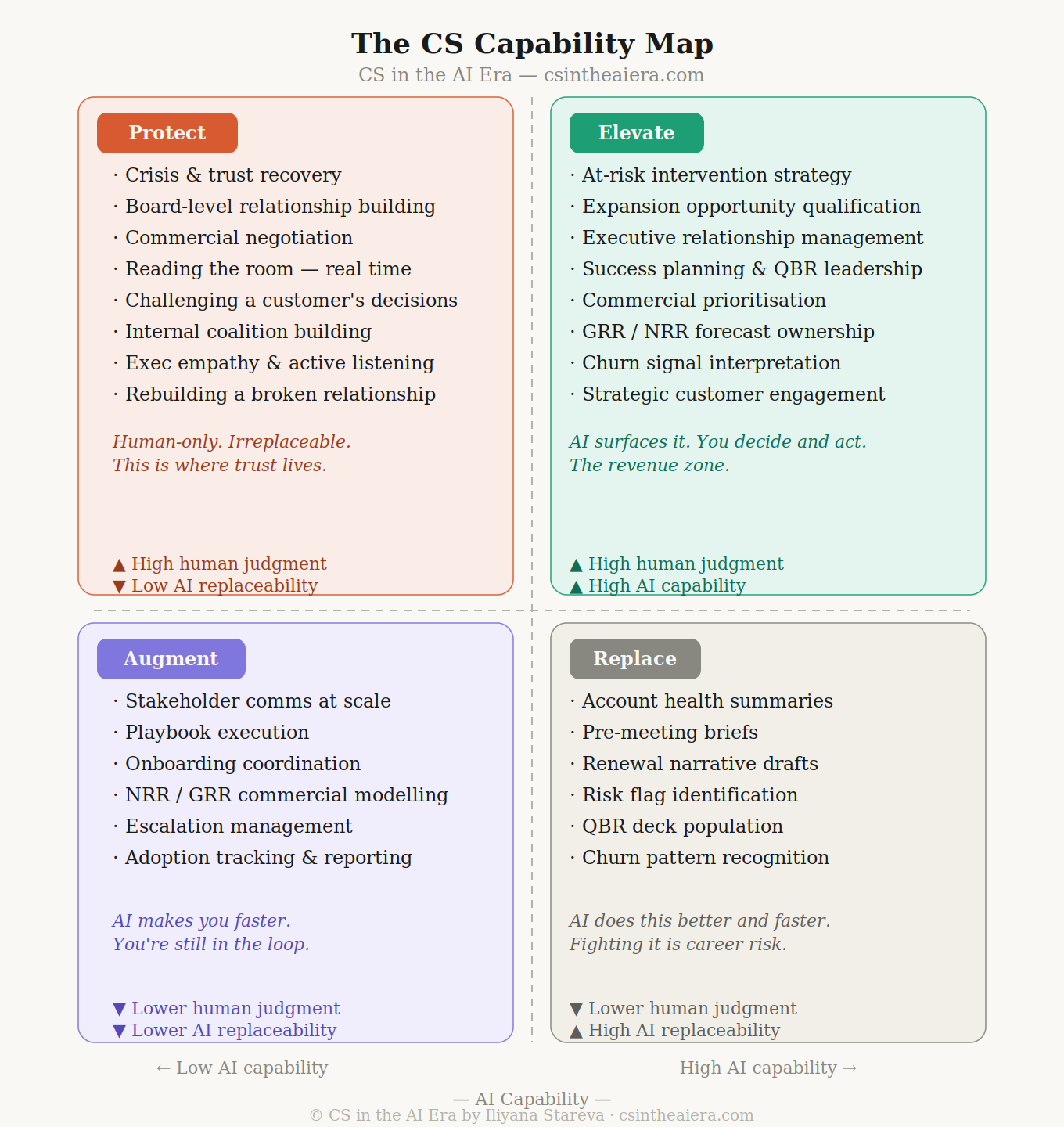
Replace — AI does this better and faster. Fighting it is career risk. Tasks here: account health summaries, renewal narratives, risk flag drafts, meeting prep briefs, churn pattern recognition, QBR population, adoption reporting.
Augment — AI makes you significantly faster, but you're still in the loop. Tasks here: stakeholder communication at scale, playbook execution, onboarding coordination, commercial modelling, NRR forecasting, escalation management.
Elevate — AI surfaces the signal; you're the one who decides what to do with it. Tasks here: at-risk intervention strategy, expansion opportunity qualification, executive relationship management, success planning, commercial prioritisation.
Protect — Human-only, irreplaceable. The work that requires judgment, trust, and presence. Tasks here: board-level relationship building, crisis management, commercial negotiation, challenging a customer's internal decision-making, reading a room and changing your approach in real time, building the coalition inside a customer account that actually drives adoption.
Here's the uncomfortable truth: most CS leaders are spending the majority of their time in Replace and Augment. The market is now paying — and increasingly, only paying — for the people who operate predominantly in Elevate and Protect.
Where you spend your time is a strategic choice. Make it consciously.
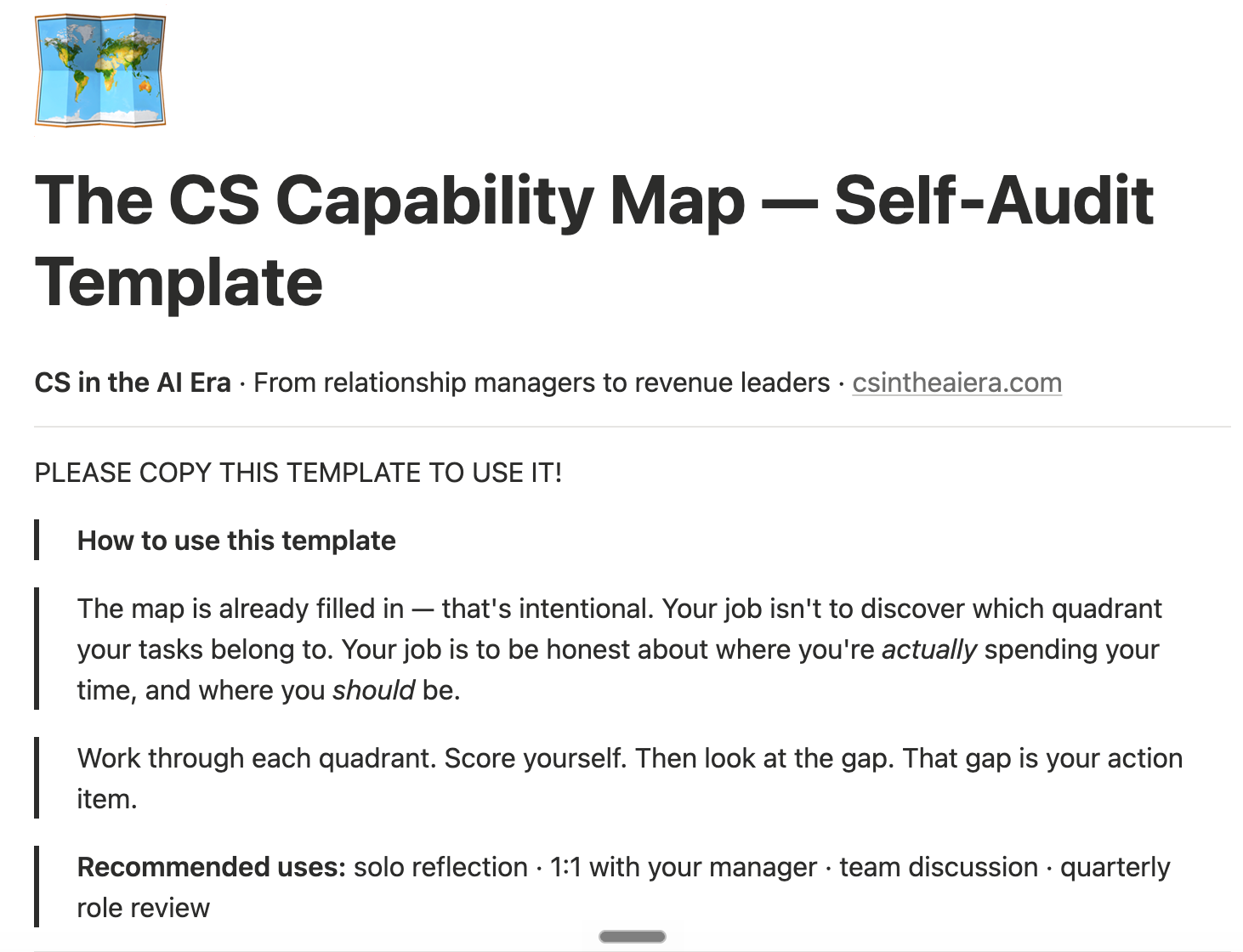
I've made it easy for you and create a Notion template you can use right away to assess your CS capability map. Grab it below!
The talent blind spot that's going to cost us
There's a version of the AI-in-CS conversation that I see playing out in organisations right now, and it worries me more than any of the restructuring data.
CS leaders are automating the Replace tasks — rightly so — and concluding that they no longer need as many junior CSMs. The efficiency case is real and the cost reduction is immediate. The problem is what we're actually destroying in the process.
Seniority in people is only achieved by experience. The CSM who can hold a difficult executive conversation, read a room, make a judgment call under pressure — that person didn't arrive like that. They developed those capabilities by doing the work: writing the renewal narratives, building the pre-meeting briefs, sitting in the account reviews, making the early mistakes. Those "replaceable" tasks were also the training ground.
When we automate the entry point, we cut the pipeline that produces the experienced CS leader in five years. We gain efficiency now and create a capability crisis later.
The 2026 State of CS data signals this tension clearly. 66.8% of CS teams have no dedicated enablement function. 20.1% provide neither product nor sales training to their CSMs. One survey respondent described their onboarding as "sink or swim." Another said, simply: "We don't."
AI makes this worse in an unstructured team, not better. As one expert in the report put it: you're handing powerful tools to people who were never taught the underlying motion.
CS leaders who are serious about the Protect quadrant need to invest in building it deliberately — not assume it arrives with tenure. The work that AI cannot do doesn't develop itself.
What this actually means for you
The question worth sitting with isn't "will AI replace my role?" The honest version of that question is: "Am I spending my time where AI can't go?"
If you're still the person doing the account health summaries, the renewal narrative drafts, the risk flag writeups — not because you want to, but because your organisation hasn't made the tooling investment — that's a different problem. It's a data and infrastructure problem and it has a business case attached to it.
But if the tooling is there and you're still doing those tasks because they feel safe and familiar and measurable — that's the thing to interrogate. Safety in Replace is not security; it's exposure.
The revenue-generating CS leader lives in Elevate and Protect. That's where the commercial conversations happen. That's where trust gets built and defended. That's where the business case for CS as a function gets made, or doesn't.
The line is clear. The choice is yours.
— Iliyana
Next issue, 20 July: Reactive Customer Success Has a Price Tag. Most CS Leaders Just Don't Know What It Is. I'm going to give you the calculation.
CS in the AI Era is a bi-weekly newsletter for Customer Success leaders in European SaaS. If someone sent this to you and you want to receive it directly, subscribe here. Or if you know a CS leader who should read it? Forward it.