Reactive Customer Success Has a Price Tag. Most CS Leaders Just Don't Know What It Is.
Reactive CS feels like effort. Economically, it's a compounding leak. Here are the five places it costs you money — and a model to quantify it for your CRO.

The leaky bucket was always there. We just never counted the water.
In every company I've worked at — HubSpot, Cisco, ServiceNow — some version of the same conversation happened: a customer is about to churn, the CSM and AE are surprised, escalations begin, and leadership gets involved. Someone says we should have caught this earlier. And then we move on to the next fire.
The leaky bucket has a name in CS. What it rarely has is a number.
That's the problem I want to fix in this issue — because the "we need to be more proactive" conversation has been happening in CS for a decade, and it's still not working. Not because CS leaders don't believe it, but because they haven't had the financial language to make anyone else believe it too.
What reactive CS actually costs
Reactive CS doesn't look like failure; it looks like effort. It looks like a full Slack channel, a packed escalation call, a CSM who stayed late to rescue a renewal. It feels heroic in the moment, but it's compounding financial damage in aggregate.
The model most CS orgs are still running is essentially this: wait for a signal bad enough to be unmissable, then deploy people and executive time to contain it. The customer either stays or churns. Move on.
The economics of that model are worse than most boards realise and most CS leaders can't articulate why, because they're measuring activity rather than cost.
There are five places where reactive CS leaks money — not metaphorically, but structurally.
1. Forecast instability
When you don't know which accounts are at risk until they tell you, your GRR forecast is a guess dressed as a number. Every quarter, CS leaders present renewal confidence based on incomplete signals; finance then builds revenue plans on top of that. When the forecast misses — and reactive CS organisations miss more often — the cost isn't just the lost revenue. It's the credibility hit that makes every subsequent forecast harder to defend.
2. Expansion delay
The accounts most ready to expand are almost never the ones getting the most CSM attention in a reactive model. The accounts getting the most attention are the ones on fire. Which means expansion conversations happen late, if at all; the CSM is too busy fighting yesterday's problem to build tomorrow's revenue. A single quarter of expansion delay across a €5M book of business is a number worth putting in front of your CRO.
3. Escalation overhead
An executive escalation costs more than it looks. There's the CSM time, the CS leader time, the executive sponsor time, the involvement of Sales, Product, Support — sometimes Legal. One serious escalation can consume 30–40 hours of senior time. Multiply that by the number of escalations your team handles in a quarter and the number gets uncomfortable quickly.
4. CSM burnout and attrition
Reactive CS organisations have higher CSM turnover. The correlation is consistent enough that I'm confident stating it: CSMs who spend the majority of their time firefighting — rather than building relationships, running strategic conversations, and seeing accounts improve — burn out faster. Replacing a CSM costs ca. 50–75% of their annual salary when you account for recruiting, onboarding, and the productivity gap while the new hire ramps. That's a people cost most CS budgets don't track explicitly.
5. Sales trust erosion
This one is harder to quantify but the most strategically damaging. When CS can't reliably identify at-risk accounts before Sales hears about it from the customer, the relationship between CS and Sales degrades. Sales stops looping CS in early, CS gets less context on new accounts and the handoff quality drops. It becomes a self-reinforcing problem and it makes cross-sell and upsell motions significantly harder to execute. The commercial impact is real even if no one has put a number on it.
Why my function exists
Part of the reason Customer Health Assurance exists at ServiceNow and why it was created as a distinct function is that the traditional CS model wasn't catching problems early enough. We were operating in the reactive window, not the preventive one.
Since we've been running a more structured, signal-based approach, we've contributed to a few points improvement in GRR. A few points might sound modest, but at enterprise scale, a few points of GRR is significant — both to the revenue line and to the valuation multiple, since net revenue retention is one of the primary metrics investors and boards use to assess the health of a SaaS business.
What made the difference wasn't more CSMs and it wasn't a better health score dashboard. It was systematic signal capture — alerts that fire when something even remotely begins to feel wrong: a drop in product engagement over a few weeks, a piece of news suggesting the customer is going through a restructure, a pattern of declining meeting attendance. Not red flags but early yellows.
The alternative to reactive isn't just proactive. It's systematic.
The Reactive CS Cost Model
If you are struggling to move your CS org from reactive to proactive, it's often because you don't have internal buy-in.
And as always in big organisations, if you want something to change, you need to first build the business case. Here's how you can do it in this instance.
Just note, the goal isn't a precise figure — it's a defensible estimate that shifts the conversation from "we should be more proactive" to "here's what not being proactive is costing us."
Run these five calculations for your current book of business:
- Forecast variance cost — What was your GRR forecast vs actual over the last four quarters? Multiply the variance by your average contract value. That's your forecasting miss in revenue terms.
- Expansion delay cost — How many accounts had expansion conversations that started in the second half of the year rather than the first? Estimate the NRR impact of those conversations happening one quarter earlier.
- Escalation overhead — Count your executive escalations last quarter. Multiply by a conservative estimate of senior time (15 hours per escalation × blended hourly cost of people involved). This is a real cost most CS orgs don't track.
- CSM attrition cost — How many CSMs did you lose in the last 12 months? Multiply by 60% of their average annual salary. That's the replacement cost floor.
- Sales trust deficit — Harder to quantify; use this as a forcing question instead. When did Sales last come to CS proactively before a deal was at risk? If the honest answer is "rarely," the cost is buried in pipeline and expansion metrics you aren't attributing correctly.
Add the five numbers. The total is almost always larger than the investment required to build a proper signal-based health system. That's the number you bring to your CRO.
The prompt for this issue
"I want to build an internal business case for moving from reactive to proactive, signal-driven CS. Help me estimate the cost of our current reactive posture using these five leakage points: [paste your numbers or estimates]. Then help me draft a one-page executive summary I can bring to my CRO."
Run it in Claude or your AI of choice. Use the five calculations above as your inputs. The output won't be perfect — but it will be specific, and specific is what moves budget conversations.
Or, I've built this as a working Notion template so you can fill it in against your own book of business. It takes about 20 minutes. The link is below — free, no gate. The output is a number you can bring to your next CRO conversation.
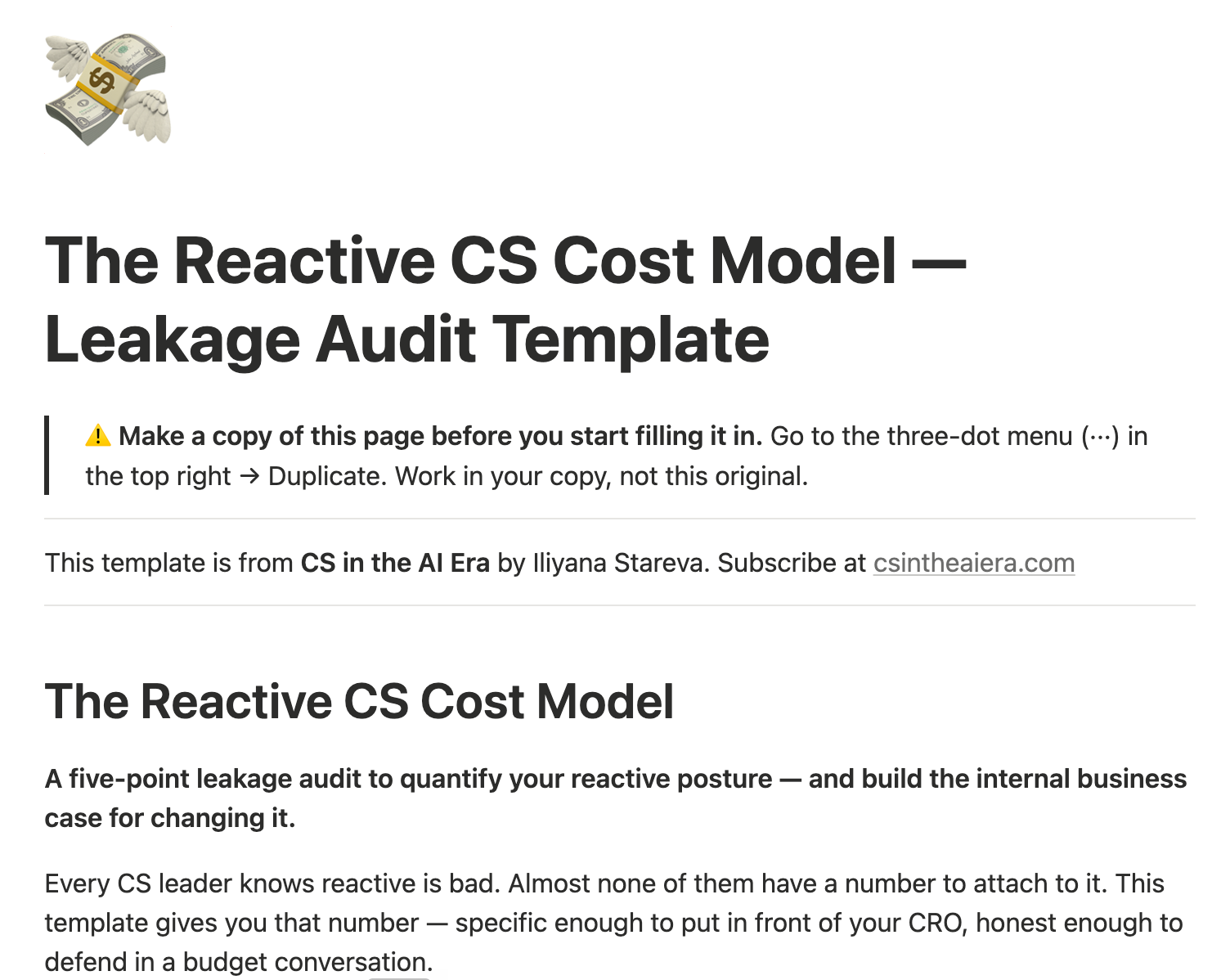
A five-point leakage audit to quantify your reactive posture — and build the internal business case for changing it.
How have you made CS more proactive?
— Iliyana
Next issue: Your health score is green. Your account is about to churn. Here's why — the five silent signals that appear 60–90 days before churn and almost never show up as red in standard health models.
CS in the AI Era is a bi-weekly newsletter for Customer Success leaders in European SaaS. If someone sent this to you and you want to receive it directly, subscribe here. Or if you know a CS leader who should read it? Forward it.